
The Direct Line of Transmission in Yizong Baguazhang
The Yizong lineage—tracing from Zhang Junfeng to Hung Yixiang to Luo Dexiu—represents one of the most technically complete transmissions of Baguazhang and internal martial arts available today. Unlike fragmented or reconstructed systems, this lineage preserved not only forms but the underlying biomechanical principles that make internal power functional. When practitioners ask what distinguishes one Baguazhang school from another, the answer lies in the completeness and clarity of transmission: whether the teacher received the full method and can explain why movements generate power, not just what the movements look like.
This article examines the three-generation core of the Yizong transmission, focusing on what each master contributed to the preservation and clarification of internal martial arts as a system of efficient force generation.
Zhang Junfeng: Synthesizing Multiple Complete Systems
Zhang Junfeng (張俊峰, 1909-1993) was not a collector of forms but a synthesizer of complete martial systems. He trained extensively in Baguazhang under Gao Yisheng (high-level student of Cheng Tinghua), Xingyiquan under Zhang Zhaodong (student of Li Cunyi and another Cheng Tinghua disciple), and Taijiquan under multiple teachers. What made Zhang’s transmission valuable was his insistence on understanding the structural principles underlying all three arts.
Zhang recognized that despite different training methods and tactical preferences, internal arts share common biomechanical foundations: pelvic structure as the power source, spinal alignment for force transmission, and limb relaxation to eliminate conflicting muscle tensions. He taught these arts not as separate systems but as complementary approaches to the same mechanical principles. His Baguazhang emphasized continuous footwork and angular entries, Xingyiquan focused on linear compression and release, and Taijiquan developed sensitivity to incoming force vectors.
By the time Zhang began teaching in Taiwan after 1949, he had refined a teaching methodology that moved students systematically through:
- Fundamental standing postures (zhan zhuang) to establish pelvic structure and spinal loading patterns
- Basic stepping methods (bai bu, kou bu, ba bu) to maintain structure during directional changes
- Single-palm changes isolating specific force paths before combining them
- Complete palm changes integrating footwork, waist rotation, and arm extension timing
This systematization allowed transmission of internal power development as a trainable skill rather than an intuitive gift.
Hung Yixiang: Testing and Refining the Method
Hung Yixiang (洪懿祥, 1925-1993) began training with Zhang Junfeng in the early 1950s and continued for over three decades. Where Zhang was scholarly and systematic, Hung was intensely focused on making every technique functionally reliable. He tested the methods extensively, both in arranged matches and against skilled practitioners from other systems visiting Taiwan.
Hung’s contribution to the Yizong lineage was insisting that internal principles must work under pressure against non-compliant opponents. He identified common training errors where practitioners performed forms correctly but couldn’t apply power because they misunderstood the timing of force release. A palm change might look correct, but if the weight shift completes before the arm extends, or if the waist rotation finishes after the hand arrives, the structure cannot transmit force efficiently.
Hung developed specific training protocols to address these timing issues:
- Freeze-frame analysis: Stopping at key points in movements to verify spinal alignment and weight distribution
- Resistance training: Having partners provide measured resistance at different points to identify structural breaks
- Speed variation: Performing techniques at different speeds to ensure timing relationships remained correct
He also emphasized that “song” (鬆, often mistranslated as “relaxation”) doesn’t mean limpness but rather the elimination of antagonistic muscle tensions. A properly structured arm is mechanically connected from hand to spine—it feels relaxed because no muscles are fighting each other, but it can instantly transmit ground force because the bones are properly aligned.
Hung’s teaching was demanding and precise. Students learned to feel the difference between cosmetically similar movements—one structurally connected, the other broken at the shoulder or kua (hip crease). This attention to detail preserved the functional essence of Zhang’s transmission.
Luo Dexiu: Systematizing for Modern Transmission
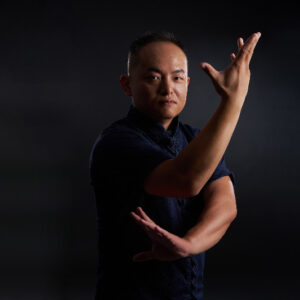
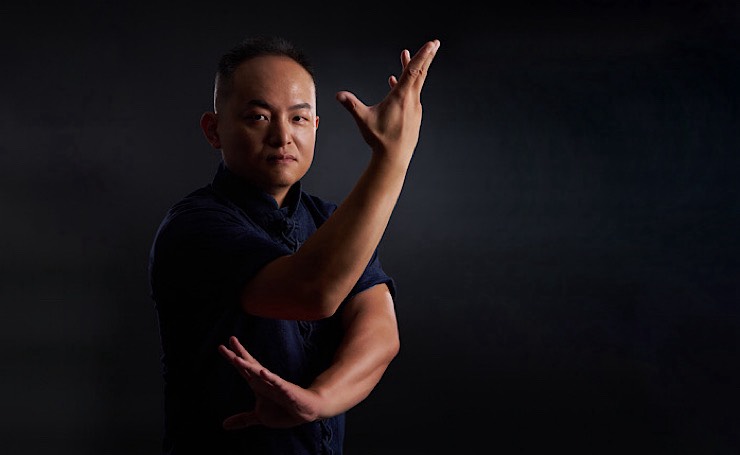
Luo Dexiu (羅德修, b. 1965) began training with Hung Yixiang in 1980 at age fifteen and received comprehensive instruction in all three internal arts plus Taiji weaponry. After Hung’s death in 1993, Luo became the primary carrier of this lineage’s complete technical curriculum.
Luo’s contribution has been making the transmission method more accessible without diluting technical standards. He recognized that modern students—often starting later in life, training part-time, and lacking cultural context—needed more explicit explanations of principles that earlier generations absorbed through longer apprenticeships.
Luo developed detailed verbal and visual models explaining:
- Pelvic mechanics: How the kua fold and unfold to generate rotational power, with specific angles and timing
- Spinal loading: The difference between compressive loading (storing potential energy) and tensile loading (dissipating force)
- Force vectors: Why circular footwork in Baguazhang creates diagonal force paths that are harder to detect and counter than linear strikes
He also preserved Hung’s testing culture while adapting it for modern contexts. Rather than challenge matches, students learn to apply principles through structured partner drills with progressive resistance, then in controlled sparring that gradually increases unpredictability.
Luo has taught internationally for over two decades, developing a network of certified instructors who maintain the lineage’s technical standards. This represents a shift from individual transmission to institutional preservation—necessary for the system to survive in the modern era without fragmenting into personality-driven variations.
What the Yizong Lineage Preserves
The value of tracing a lineage isn’t ancestor worship but identifying what’s been preserved through selection pressure. Each generation of the Yizong line faced the question: does this actually work, and can I transmit it clearly enough that my students can make it work?
What survived this filtering process is a training methodology that:
- Develops internal power as measurable improvements in force generation efficiency
- Explains techniques through biomechanics, not metaphors
- Provides systematic progressions from basic postures to complex applications
- Tests understanding through partner work, not solo performance
The Yizong lineage from Zhang Junfeng to Hung Yixiang to Luo Dexiu represents three generations of refinement in how internal martial arts can be trained, understood, and transmitted. For serious practitioners, this lineage offers not just techniques but a proven methodology for developing structural power that functions under pressure.
If you’re interested in exploring these principles further, we’ve created a free guide covering the fundamental training methods that form the foundation of Yizong Baguazhang. The 5 Foundations of Baguazhang breaks down the essential structural principles and basic training methods. You can download it at https://yizongtw.com/free-guide/.
Frequently asked questions
Who was Hung Yixiang’s teacher?
Hung Yixiang’s primary teacher was Zhang Junfeng, under whom he trained from the early 1950s until Zhang’s death in 1993. He learned the complete Yizong curriculum of Baguazhang, Xingyiquan, and Taijiquan.
What does Yizong mean in Chinese martial arts?
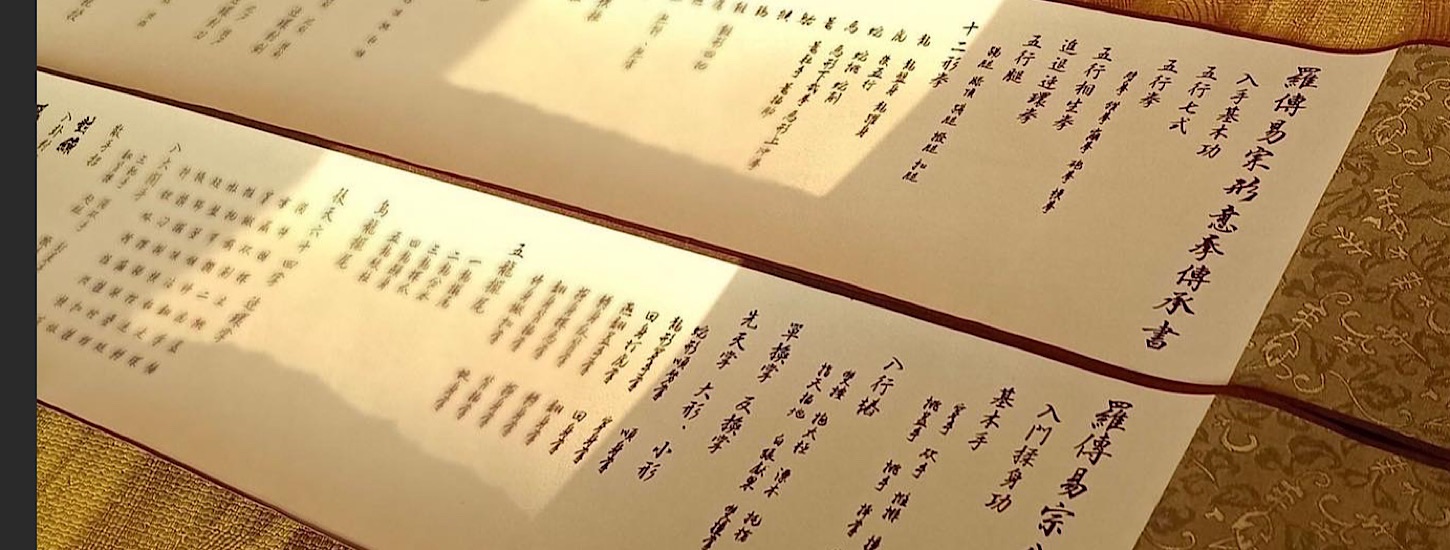
Yizong (義宗) means ‘righteous lineage’ and refers to the specific transmission of Baguazhang, Xingyiquan, and Taijiquan from Zhang Junfeng through Hung Yixiang to Luo Dexiu. It emphasizes direct, complete transmission of functional internal power methods.
Is Luo Dexiu still teaching Baguazhang?
Yes, Luo Dexiu continues to teach and has developed an international network of certified instructors who maintain the technical standards of the Yizong lineage. He teaches both in Taiwan and through seminars worldwide.
What makes Yizong Baguazhang different from other styles?
Yizong Baguazhang emphasizes verifiable biomechanical principles over mystical explanations, systematic progression from basic structure to applications, and continuous testing of techniques under resistance. The lineage preserved complete training methodology, not just forms.