

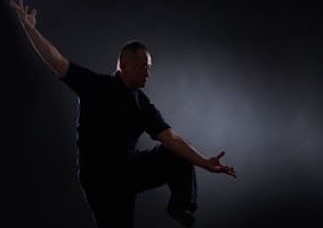


When experienced internal martial artists demonstrate rooting, beginners often describe it as mysterious or magical. There’s nothing mysterious about it. What you’re witnessing is six-direction structure—a specific biomechanical arrangement where force pathways extend simultaneously up/down, forward/back, and left/right through the body. This framework, fundamental to Baguazhang, Xingyiquan, and Taijiquan, creates a connected structural system that’s genuinely difficult to uproot, collapse, or move because forces applied to any point distribute throughout the entire skeletal lattice rather than accumulating at the point of contact.
What Six-Direction Structure Actually Means
Six-direction structure refers to opposing force vectors extending from your center of mass along three spatial axes. Think of it as an internal scaffolding where you’re simultaneously:
- Pushing down into the ground while the ground’s reaction force pushes back up through your skeleton
- Extending forward through the front of your body while maintaining a countering pull back through your spine and rear
- Opening laterally outward through both sides while maintaining inward structural cohesion
This isn’t imagination or visualization. It’s physical tension—not muscular tension that fatigues, but structural tension created by positioning bones and connective tissue in specific geometric relationships. When your femur sits properly in the hip socket with your knee tracking correctly over your foot, and your pelvis tilts to the precise angle that allows your spine to stack vertebra by vertebra, you create force pathways that channel incoming energy directly into the ground.
In the Yizong Baguazhang system passed down through Luo Dexiu, we drill this structure relentlessly in standing practice, walking the circle, and partner work. It’s not conceptual—it’s testable. A training partner pushes you, and either the force dissipates through your structure into the ground, or it accumulates in your body and moves you. The feedback is immediate and honest.
How Six-Direction Structure Makes You Hard to Move
When someone pushes you and you resist with muscular strength, you create a direct force-against-force contest that the stronger person wins. When you possess proper six-direction structure, something different happens: the incoming force travels through your skeletal system along established pathways and disperses into the ground before it can accumulate enough to uproot you.
Consider the engineering principle of a properly built arch bridge. The weight of cars crossing it doesn’t collapse the bridge because the structure redirects vertical loads outward through the arch and down into the foundations. Your body works similarly. An incoming push at chest level doesn’t simply compress your chest muscles—it travels down through your spine, through your pelvis, through your legs, and into the ground, if those segments are correctly aligned.
This requires three specific conditions:
- Skeletal alignment: Joints stacked and angled to create continuous pathways from point of contact to ground
- Connective tissue integration: Fascia, tendons, and ligaments engaged (not slack) to transmit force between bones without muscular clenching
- Ground connection: Feet positioned and weighted to accept and redirect incoming forces
What makes you specifically hard to move is that pushes from any angle encounter this three-dimensional matrix. Push from the front, and forward/back structure redirects it. Push from the side, and left/right structure handles it. Try to lift or press down, and up/down structure resists. The attacker isn’t facing a single point of muscular resistance—they’re attempting to overcome an entire architectural system.
The Role of Timing and Micro-Adjustments
Static structure alone isn’t enough. Real application requires constant micro-adjustments as forces change direction and intensity. This is where years of training matter. When a training partner pushes, you’re not locked in position—you’re making millimeter-level changes to joint angles, weight distribution, and spatial relationships to maintain optimal force pathways as conditions change.
In Baguazhang, we develop this adaptive capacity through circle walking. The continuous spiraling motion requires you to maintain six-direction structure while constantly changing orientation, step size, and elevation. You learn to find structural integrity not just in one perfect stance, but throughout continuous movement. The circle walking isn’t mystical meditation—it’s biomechanical skill development under controlled conditions.
Timing enters when you recognize that structure doesn’t mean rigidity. There’s a specific moment when incoming force loads into your structure where you have maximum mechanical advantage. Respond too early, and you’re using muscle to block. Respond too late, and the force has already compromised your alignment. The training develops your sensitivity to detect force arrival early enough to make structural adjustments before the push fully commits.
Building Six-Direction Structure: The Training Reality
Developing functional six-direction structure takes significant time because you’re literally reconditioning how your nervous system organizes your body. Most people have spent decades using muscular effort for stability. Teaching your body to rely on skeletal alignment and connective tissue instead requires consistent, patient practice.
In our Yizong Baguazhang curriculum, students work through specific progressions:
- Standing practice (zhan zhuang): Hold specific postures that establish basic six-direction relationships, usually starting with 5-10 minutes and gradually extending duration as structural efficiency improves
- Partner testing: A training partner applies gentle, sustained pressure to test whether your structure holds or whether you’re substituting muscular effort
- Circle walking: Maintain six-direction structure through continuous direction changes and varying speeds
- Application drilling: Use the structure in specific martial contexts—deflections, strikes, throws—where it must function under dynamic pressure
The key is honest feedback. If a 150-pound student can easily push you when you outweigh them by fifty pounds, your structure has gaps. This isn’t a failure—it’s diagnostic information. You adjust, test again, and gradually eliminate the structural weaknesses.
Common Misconceptions About Internal Structure
The biggest misconception is that internal power is somehow separate from biomechanics. It’s not. When masters from previous generations talked about “qi” in the context of martial application, they were often describing specific physical sensations that accompany correct structure—the feeling of ground reaction force traveling up through your legs, the sensation of connective tissue bearing load, the proprioceptive awareness of bones aligning. The language was different; the physical reality was not.
Another misconception: that relaxation alone creates structure. You’ll hear “relax” constantly in internal arts schools, but what’s meant is release unnecessary muscular tension while maintaining structural integrity. A completely relaxed person collapses. Proper structure feels surprisingly effortless compared to muscular resistance, but it’s not the absence of all tension—it’s the presence of the right kind.
Finally, some believe structure is static—find the perfect position and hold it. Real application requires structure that adapts. The six directions remain constant as principles, but their physical expression changes frame by frame as you move, respond to attacks, and change position. Training develops the ability to find optimal structure in any position, not just carefully arranged stances.
If you’re interested in developing these foundational skills in Baguazhang, we’ve created a detailed guide that breaks down the essential training elements. You can download The 5 Foundations of Baguazhang free at https://yizongtw.com/free-guide/—it’s a practical resource for serious practitioners looking to build genuine internal structure.
Frequently asked questions
What is six-direction structure in internal martial arts?
Six-direction structure is a biomechanical arrangement where your skeleton simultaneously extends force along three axes: up/down, forward/back, and left/right. This creates interconnected force pathways that redirect incoming pushes or strikes through your structure into the ground, making you difficult to move or uproot without relying on muscular strength.
How long does it take to develop six-direction structure?
Noticeable structural stability typically emerges within 6-12 months of consistent practice (standing work, circle walking, and partner testing several times weekly). Functional skill under pressure usually requires 2-3 years, and genuine mastery is measured in decades. Progress is individual and depends on practice quality, not just time invested.
Is six-direction structure the same as rooting?
Six-direction structure is the mechanism that creates what people call rooting. Rooting is the observable result—stability and resistance to being moved—while six-direction structure describes the specific skeletal alignment and force pathways that produce that result.
Can you use six-direction structure while moving?
Yes, and that’s essential for martial application. Static structure in one stance is just the beginning; advanced practice develops the ability to maintain structural integrity through continuous movement, direction changes, and dynamic responses to attacks. Baguazhang’s circle walking specifically trains this adaptive structure.
Do you need strength to have good internal structure?
You don’t need exceptional muscular strength, but you do need healthy connective tissue and bones capable of bearing load. Internal structure is more efficient than muscular resistance, which is why smaller practitioners can sometimes outperform larger ones, but it’s not magic—basic physical conditioning still matters.