7/25〈站樁・單換掌〉一日工作坊・竹北・限 12 席,報名中 →
Free Guide Patreon Access Seminar

The Five Element Fists of Xingyi, Explained

Xingyiquan is the most direct of the internal arts — shortest path, straight to the target. Its heart is the Five Element Fists: splitting, drilling, crushing, pounding, and crossing (pi, zuan, beng, pao, heng).

Not five techniques — five ways force moves

The common mistake is to treat them as five separate strikes to memorize. They’re better understood as five directions and qualities of power: splitting drops and chops, drilling spirals forward, crushing drives straight, pounding erupts upward-outward, crossing cuts across. Learn the quality and the applications multiply.

Whole-body power, shortest path

Each fist is trained to issue power from the ground through the whole connected frame in the most efficient line possible. This is why Xingyi practitioners hit disproportionately hard for their size — it’s structure and timing, not muscle.

Where it fits

In our Yizong lineage, Xingyi’s directness complements Baguazhang’s positioning. Many practitioners train both: Xingyi for issuing power, Bagua for controlling the frame of a fight.

Get the full Five Elements and Twelve Animals breakdowns on my Patreon →
Enjoyed this insight? Click like to let us know
Every like helps us continue sharing knowledge.

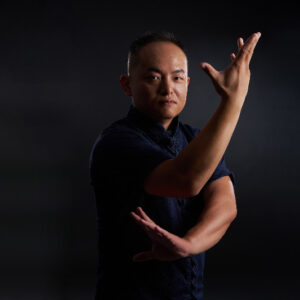
Chang Tung-i is the senior student and last indoor disciple of Luo Dexiu, founder of Yizong Baguazhang. For nearly 15 years, he has engaged in intensive weekly private study under Master Luo, developing a refined understanding of internal mechanics, structural alignment, and movement strategy. Graduating with a degree in Physics from National Chiao Tung University, Wenteng applies a systems-level analytical approach to martial practice—decoding principles through the lens of force dynamics and structural mechanics. This scientific foundation enables him to bridge traditional martial concepts with clear, functional explanations. His martial experience spans disciplines, from Yagyu Shinkage-ryu swordsmanship to MMA competition, demonstrating his ability to adapt and integrate core principles across diverse systems. Wenteng’s teaching transcends stylistic boundaries. He focuses on shared internal principles that hold true regardless of form or lineage, helping practitioners develop proprioception, timing, and multi-joint coordination. His method is grounded in sensory clarity and technical simplicity, guiding students toward profound functional insight and cross-system coherence. Rather than promoting stylized movement or emotional narratives, Wenteng’s work emphasizes applicable, real-world skill—the transmission of embodied knowledge through dedicated practice. 本名 張文騰 · Chang Wen-teng

Looking for more insights on timing, structure, and internal release?
Browse our full article archive below.

Related Post

EN TW JP
Table of contents